

In automated assembly and material handling, the choice of a transfer medium isn’t just a technical detail—it’s the heartbeat of your production efficiency. Choosing the wrong system can lead to costly jams, high maintenance, and precision loss. This guide breaks down the critical differences between Belt, Chain, and Timing Belt pallet conveyor systems, helping you select the ideal configuration for your facility’s specific throughput and precision requirements.
目次
- Flat Belt Conveyors: The Versatile Workhorse
- Roller Chain Conveyors: Built for Heavy Duty
- Timing Belt Conveyors: The Gold Standard for Precision
- Side-by-Side Comparison: Belt vs. Chain vs. Timing Belt
- Why Vitrans Specializes in Multi-Medium Solutions
- よくある質問(FAQ)
Flat Belt Conveyors: The Versatile Workhorse
Flat belt pallet conveyors are the most common entry point for general transport. They rely on friction to move pallets along the line.
- Pros: Cost-effective, quiet, and easy to replace. Ideal for lightweight electronics and plastic parts.
- Cons: Susceptible to “belt slip” under heavy loads; not suitable for high-precision indexing.
Roller Chain Conveyors: Built for Heavy Duty
When you are moving heavy engine blocks, metal castings, or large EV battery packs, roller chain conveyors are the industry standard. These systems use hardened steel chains to provide a positive drive that can handle thousands of kilograms.
- 最適: Harsh environments, oily parts, and high-load accumulation.
- Maintenance Note: Requires regular lubrication and tensioning to prevent “chain stretch” over time.
Timing Belt Conveyors: The Gold Standard for Precision
For modern robotics and 6-axis assembly, precision is non-negotiable. Timing belt (Toothed Belt) pallet conveyors utilize a positive-mesh drive system that eliminates slippage. By interlocking the belt’s teeth with the drive pulley, these systems achieve micron-level repeatability.
- 正確さ: Achieves repeatable positioning accuracy of up to ±0.05mm.
- Cleanliness: Ideal for medical and semiconductor “cleanroom” environments as they require no messy lubrication.
Pallet Conveyor Comparison Table
| 特徴 | 平ベルト | Roller Chain | Timing Belt (Vitrans) |
|---|---|---|---|
| ドライブタイプ | Friction | Positive (Chain) | Positive (Toothed) |
| 精密 | 低い | 中程度 | 非常に高い |
| Max Load | ミディアム | Very Heavy | ミディアムからヘビー |
| 潤滑 | Not Required | Regularly Needed | Maintenance-Free |
| 騒音レベル | 低い | 高い | Very Low |
Why Vitrans Leads in Pallet Conveyor Innovation
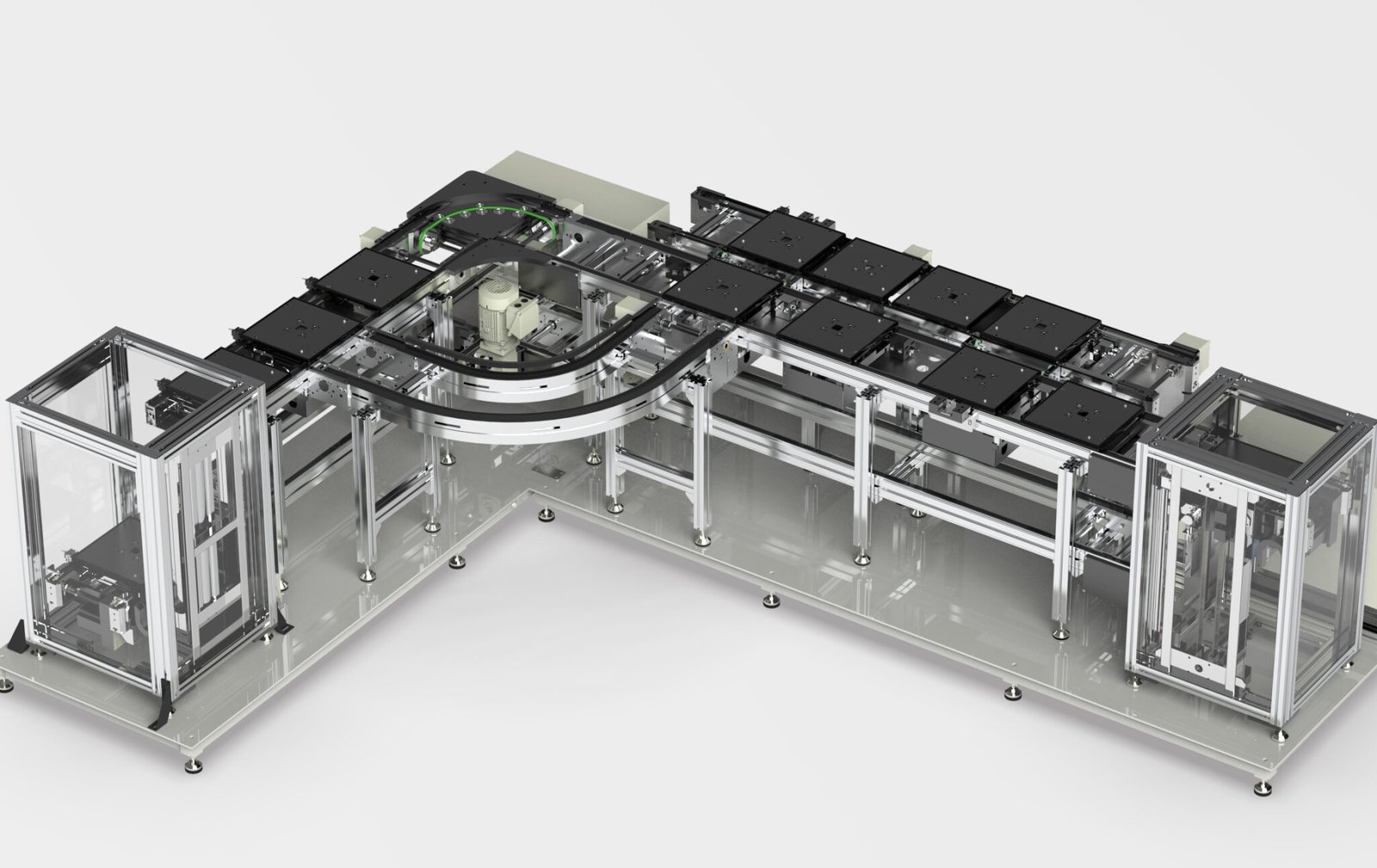
で Vitrans Automation, we don’t believe in one-size-fits-all. Our modular pallet systems are designed to be agnostic, allowing you to mix and match transfer mediums within a single line. Whether you need the brute strength of a Roller Chain for your main line or the high-speed precision of a タイミングベルト for your robotic cells, Vitrans components are engineered for seamless integration.
よくある質問(FAQ)
1. When should I switch from a flat belt to a timing belt?
If your process requires stopping a pallet at a robotic station with ±0.1mm accuracy without external locating pins, a timing belt is essential.
2. Does Vitrans provide CAD drawings for system planning?
Yes, we offer full modular 3D CAD support to help engineering teams integrate our conveyor units into their facility layouts rapidly.
3. Can your systems operate in ESD-sensitive environments?
Absolutely. We offer ESD-rated timing belts and conductive chains specifically for electronics manufacturing.
Looking to upgrade your assembly line? Contact Vitrans today for a custom pallet conveyor consultation.